
The Meta Ads Creative Strategy Framework That Actually Works: The COLOURFUL™ Method
Most eCommerce brands running Meta Ads are doing it backwards. They open Ads Manager, build something that looks decent, hit publish and then wonder why nothing's scaling. That's not creative strategy. That's expensive guesswork.
A robust Meta Ads creative strategy framework changes everything. It's the system that sits between your business goals and your ad account, turning random testing into repeatable, compounding results.

At White Bee Digital, we built our own: the COLOURFUL™ Creative Strategy Framework.
It's a nine-step proprietary process used by our agency every single month across our client accounts. We trademarked it because it works, and it works because it's rooted in data, buyer psychology and creative best practice rather than gut instinct and trends.
This guide walks you through the full framework. By the end, you'll understand exactly why your ads aren't scaling and what a proper creative strategy process looks like.



A Meta Ads creative strategy framework is a repeatable system for planning, creating, testing and analysing your ad creative. It answers the questions most advertisers never stop to ask: who am I talking to, what am I saying, why does that message matter to them, and how will I know if it's working?
It's not about aesthetics. It's not about picking a nice colour palette or writing a catchy headline. It's the strategic thinking that happens before you open Ads Manager.
Creative strategy is the thinking that happens before you touch the ad account. Most advertisers skip this completely.
What Is a Meta Ads Creative Strategy Framework?
Why creative strategy is now non-negotiable on Meta
Meta's algorithm has fundamentally changed how ads are matched to audiences. The old approach, setting tight audience parameters and showing the same two or three ads to the same people, is obsolete.
Meta's Andromeda algorithm update accelerated this shift. Today, each ad is treated like its own mini campaign. Meta's AI scans your creative and matches it in real-time to users most likely to respond to that specific ad. Your creative is now doing the audience targeting. That means if your creative has no clear message, no defined audience signal, no strategic intent, you're feeding the algorithm junk.
You cannot scale junk.
Meta reports that 56% of ad performance comes from creatives and messaging. If you're not treating creative strategy as your primary lever for growth, you're leaving the majority of your results on the table.


Before we get into the framework, let's name what most brands are doing wrong. You'll recognise at least one of these.
The Common Mistakes That Kill Ad Performance
Copying competitors
The Meta Ads Library makes it easy to see exactly what your competitors are running. A year or two ago, copying competitors (rightly or wrongly) was standard practice. It shouldn't be now. You have no idea whether those ads are working for them. You could be copying a failing strategy. Your brand is unique. Lean into that rather than becoming a watered-down version of someone else.

Random testing
A moment of inspiration in the shower is not a creative strategy. Testing ideas without a hypothesis, without knowing who you're trying to reach or what you're trying to say, produces data you can't learn from. Everything in your ad account should have a reason for being there.
Same ad, different headline
This was the playbook 18 months ago. Run the same image with ten different text overlays and see which one wins. That approach is dead. The algorithm reads visual similarity. Ten versions of the same creative are not ten different tests. They're one test, run ten times.
Talking to the wrong awareness stage
If your ads only speak to people ready to buy right now, you're speaking to roughly 5% of your potential audience. The other 95% need a different message entirely. Most brands ignore this and then wonder why their cost per acquisition keeps climbing.
No system for tracking what's working
The brands that scale on Meta don't just launch good ads. They know exactly why each test was run, what the hypothesis was, what the result was and what to do next. Without that, every month starts from zero.
Why Your Creative Is Your Targeting Now
This is the most important shift in Meta Ads over the last two years and most brands still haven't adjusted.
Before the iOS 14.5 update and the Andromeda algorithm rollout, targeting was done in Ads Manager. You'd define your audience, show your creative to that audience and optimise from there.
Now, Meta's AI makes delivery decisions based on signals within your creative. The visuals, copy, structure and tone of your ad tell Meta who to show it to. If your ad creative is generic, Meta has no clear signal. It'll show the ad to a broad, mismatched audience and your results will be mediocre at best.
Think about it this way: if you talk to everyone, you speak to no one. That principle has never been truer in Meta Ads than it is right now.
Creative variety is now critical. The Andromeda algorithm favours advertisers who provide a range of formats, styles, hooks and tones. Different pockets of your audience respond to different types of content. Brands that show up with a diverse mix of well-thought-out creatives, from lo-fi UGC to polished product demos, give Meta more to work with and see better performance as a result.

The COLOURFUL™ Creative Strategy Framework: All Nine Steps
The COLOURFUL™ framework is our proprietary nine-step creative strategy process. It covers every stage of the process from analysis through to launch, with a feedback loop built in so your results compound over time.
Here is what each letter stands for and what it means in practice.
-
You don't know where you're going until you know where you are.
Every creative strategy cycle starts with a thorough analysis of where things stand. This is not just a case of logging into Ads Manager and checking ROAS. It's a macro-to-micro review.
Start at the top. What's happening in the world right now that could be impacting your niche? Market volatility, seasonality, political events, exchange rate shifts, consumer confidence. These are not abstract concerns. They have a direct impact on ad performance, and the brands that adapt quickly to external context outperform those that don't.
Then look at your industry. What's happening with competitors? Not to copy them, but to understand how you're positioned in the market. Do a quarterly competitor audit via the Meta Ads Library. Are there gaps in their messaging you could move into?
Then and only then, go into the ad account. What creative formats performed best? Which content creators, founders or visual styles drove results? Were there particular angles or hooks that outperformed everything else? Look for patterns.
Beyond creative performance, review your KPIs. Without clear targets for CPA, ROAS, blended return and break-even ROAS, you're flying blind. These are the north star for every decision you make.
Finally, mine your customer reviews. Use AI to extract pain points, motivations, objections and transformation stories from your reviews. The exact language your customers use to describe their problems and aspirations is your best source of ad copy. Customer insights are ad gold.
-
Once you've done the analysis, patterns emerge. Opportunities reveal themselves in the data. This step is about capturing them before they disappear.
Maybe your data shows a particular product is being bought repeatedly by a specific type of customer you hadn't targeted intentionally. Maybe there's a seasonal moment your competitors are ignoring. Maybe a recurring customer objection in your reviews is something no ad has ever directly addressed.
These are your angles. They become the foundation of your creative strategy for the next cycle.
A practical habit worth building: as you scroll your own social media feed, screenshot ads that stop you mid-scroll. Keep them in a folder and review them during creative strategy sessions. Don't limit yourself to your direct competitors. Ideas can come from entirely different niches. Sometimes it's a colour palette, a composition or a clever text overlay that sparks the perfect concept for your brand.
-
This step is the most skipped and the most costly to ignore.
Your Meta Ads do not work in isolation. They sit alongside your organic social content, your email marketing, your website and your blogs. If the message in your ads is inconsistent with everything else, you create confusion rather than trust.
Lead brand messaging means being clear on your brand's USPs, your values, who you serve and what you stand for. It means the language, tone and energy you use in your ads matches what a customer would find if they then Googled you, visited your website or saw your Instagram.
This consistency is what builds brand recognition and trust over time. Repetition sounds boring but no single customer sees everything you put out. Consistent messaging across every channel cuts through the noise and turns exposure into action.
If you're a newer brand without a full branding document, at minimum be clear on the words and phrases that feel authentically you, the ones you'd never want anyone to use about your business, and the values that drive every decision. That's enough to keep your messaging coherent.
-
Offer is one of the most misunderstood words in Meta Ads.
In this context, offer does not mean discount. It means what you are selling. Being strategic about your offer is one of the fastest levers for improving ad performance.
Focus your ad spend on your best sellers. The products with the highest conversion rate, the highest average order value or the strongest post-purchase loyalty. But best sellers aren't the only thing worth focusing on. Gateway products matter too. We work with a homeware brand whose existing customers are fiercely loyal. Every launch sells out and retention isn't the challenge. The challenge is getting new people in. We found a product priced under £20, unusually low for that brand, which became the entry point for new customers who then went on to buy four, five, six times. The offer wasn't designed to be the most profitable single sale. It was designed to acquire the right customer.
Do not run ads to products that don't sell organically. If people aren't buying without ads, putting a budget behind them won't change that.
The biggest mistake we see here is spreading budget too thin across too many offers at once. One jewellery brand we worked with wanted to launch three new collections in the same month with £100 per day total. They would have seen far stronger results by staggering those launches and giving each one the full budget at a time.
When all your marketing channels promote the same offer simultaneously, they amplify each other. Your Meta Ads, email list, organic posts and blog content all reinforce the same message. This multi-channel alignment increases the likelihood a potential customer sees your offer enough times to act on it.
-
Now you know what you're selling and who you're selling it to. Now you define the angles you'll use to reach them.
Your angles are the specific messaging directions you'll explore in your ads. They come directly from the opportunities you identified in step two: the customer pain points, motivations, objections and aspirations you surfaced from your review mining, your competitor audit and your awareness stage analysis.
This is also where targeting genuinely changes. Broad demographic targeting is dead. It was never that useful in the first place. What matters now is understanding your customer at a level of detail most brands skip entirely. Not a fluffy persona like "Sharon, 45, shops in Selfridges" but something rooted in what the reviews actually tell you. Maybe she's a homeowner with a draughty house who needs a blanket that'll last for years and doesn't mind paying a bit more for it. That's the level of specificity an angle needs. You're writing to the real customer, not an imagined one.
Think of angles as the different reasons someone might buy from you, each one speaking to a different type of person or a different stage of their buying journey. If you sell gluten-free cakes, one angle targets people with dietary needs. Another targets parents planning a child's birthday with dietary requirements. Another targets people who've been let down by dry, joyless gluten-free products before. Same product. Completely different conversations.
The five stages of awareness are the organising framework we use to ensure we're building angles across the full buying journey, not just targeting people ready to buy right now:
Completely unaware: your audience doesn't know they have a problem. Spark curiosity and surface a hidden friction point.
Problem aware: they know something isn't working but don't know the solution yet. Speak directly to the frustration.
Solution aware: they're actively comparing options. Highlight your method or philosophy.
Product aware: they know about you. Now show them what makes you the right choice. Be specific and results-driven.
Most aware: they're ready to act. Give them a clear, friction-free call to action.
Mapping your angles to awareness stages at this stage means every ad has a defined job before a single creative asset is made. You're not launching things and hoping. You're building toward intentional tests with a clear hypothesis behind each one.
-
Your angles tell you what to say. Your hooks determine whether anyone stops long enough to hear it.
A hook is the first thing that grabs attention, the visual, the text overlay, the opening line or the sound that makes someone pause mid-scroll. It is arguably the single most important element of your ad creative. You can have the best angle in the world and the most compelling offer, but if the hook doesn't stop the scroll, none of it gets seen.
Hooks work across three senses, and all three deserve attention. Visual hooks are about movement, something unexpected happening in the frame in the first second. Written hooks are your strap line or opening sentence, the words that create curiosity or speak directly to a pain point. Audio hooks shouldn't be overlooked either. ASMR-style content continues to perform strongly, and sound can do real work even though it should always be treated as a secondary layer since plenty of people scroll with the volume off.
The key discipline here is crafting results-focused hooks, ones rooted in what your customer actually wants to achieve, avoid or feel, rather than what you think sounds clever. Pull hook ideas directly from your customer review mining. The exact phrases your customers use to describe the moment before they found you, the frustration they felt, the result they wanted, are your strongest hooks. They recognise themselves in the language because it is their language.
-
Before anything gets briefed, map out what you're actually going to test.
This is the step most advertisers skip entirely, and it's the difference between a creative strategy and a creative wishlist. At this stage, you take everything you've built so far, your angles and your hooks, and you map them against each other deliberately. Which angle, paired with which hook, in which format, targeting which awareness stage? This is your testing matrix.
The point of mapping this out before briefing is that you know exactly what you're trying to achieve and why. When you get to the brief, there's no ambiguity about what's being tested or what success looks like. You've already done the thinking. The brief becomes a translation of a decision you've already made, not the place where the decision gets made.
This is also where you build in genuine variety rather than repetition. Ten ads that are really one ad with different headlines give the algorithm nothing to learn from. A proper framework for testing maps out meaningfully different combinations: different angles communicated through different formats, different hooks tested against the same angle, different awareness stages getting entirely different creative treatments. Mapping this out as a framework, rather than reacting ad by ad, is what turns testing into a system you can defend, repeat and improve.
-
This is where everything comes together into one clear document, and it sits later in the process than most advertisers think it should.
The unified brief is the single point of truth for what is being made, why it exists, what it needs to say and what the expected outcome is. Whether you're briefing a designer, a UGC creator, a videographer or just yourself, the brief removes ambiguity and keeps production on track. It includes the ad dimensions required for each placement, the format, the angle being tested, the awareness stage it's targeting, the specific product page URL and a link to relevant assets.
This is also where the swipe file belongs, and this matters more than it sounds. For years, swipe files were step one. Advertisers would scroll the Meta Ads Library, find something they liked, and build a campaign around copying it with no idea why it worked or whether it worked at all. That's the blind leading the blind.
A swipe file used at the unified brief stage is a completely different tool. By this point, you already know your angle, your hook and your format. The swipe file exists purely to communicate the visual execution. Instead of trying to describe a transition, a font pairing or an edit style in words, you can point to a reference and say "this composition, this contrast, this pacing." It's vastly easier for creatives to interpret a visual reference than a written description, and it removes a huge amount of back-and-forth.
The brief is your creative roadmap. It cuts down on production time, ensures what gets made actually delivers, and because it comes after the strategic thinking rather than before it, every reference and instruction in it has a clear reason behind it.
-
The final step is about launching with intention and curiosity rather than hope and anxiety.
You've done the analysis. You've identified the opportunities. You've aligned your messaging, focused your offer, built your angles, crafted your hooks, mapped your testing framework and written the unified brief. Now you run the campaigns.
Launch with hypotheses. Monitor how your audience responds. Document what worked, what didn't and what surprised you, because the ads that defy your expectations are often the most valuable data you'll get. Use everything you learn to inform the next cycle through the framework.
Every campaign generates data. Data generates power. By embedding this learn-and-evolve mindset into your creative strategy, your ad account becomes a living system that continuously improves. Results compound. Long-term growth becomes achievable and predictable rather than accidental, and you start the whole process again from Current Performance with a sharper picture than before.
Creative Variety: The Most Overlooked Lever in Meta Ads
One of the biggest shifts the Andromeda update demands is a move from shallow testing to genuine creative variety.
Shallow testing is running ten versions of the same static image with different text overlays. That's not ten different tests. That's one test, replicated ten times, wasting budget and confusing the algorithm.
Genuine creative variety means testing different formats (static, video, carousel), different content styles (UGC, founder-led, product demo, lifestyle), different hooks (visual, audio, text overlay), different editing paces, different settings and different storytelling angles. Each version communicates the same core message but does it in a visually distinct way.
A practical starting point: choose one product or offer, identify one awareness stage and map out five ads that each communicate the same message in a completely different way. That's a month's worth of meaningful testing from one single pass through your framework for testing.

How the Awareness Stages Change Your Creative Approach
Running ads only to people ready to buy is the most common reason eCommerce brands plateau.
Roughly 5% of any audience is ready to buy right now. The other 95% are at various stages of awareness and need a different message to move them closer to that purchase decision. If you're only running purchase-focused ads, you're fighting for the same 5% as every other brand in your niche.
Building awareness stage diversity into your creative strategy means you're building a pipeline, not just a short-term sales burst. You're making people aware they have a problem, educating them on possible solutions, showing them your specific product and, finally, nudging the ones who are ready to act.
This is also why organic content, email marketing and Meta Ads need to be aligned. Customers rarely buy after seeing one ad. They might find you on Instagram, Google you, see a Meta ad, read a blog post, get an email and then buy. The average purchase journey is not linear. Your job is to show up consistently across that entire messy, non-linear path.

Frequently Asked Questions
-
Creative production is making the ads. Creative strategy is deciding what those ads should say, who they should speak to, what format they should take and what you're trying to learn from testing them. Most brands invest heavily in production and almost nothing in strategy. This is backwards.
-
This depends entirely on your budget. On a smaller budget of £20 to £50 per day, six to ten ads in an ad set is a solid range. On larger budgets of £500 or more per day, you need significantly more creative variety for the algorithm to have enough inputs to optimise effectively. The goal is not volume for its own sake. It's meaningful variety.
-
No. This is one of the most persistent myths in Meta Ads. Static images with a strong hook and clear message regularly outperform video. Always test both formats. The format that wins will often vary by audience, awareness stage and product type.
-
Run a full COLOURFUL™ review at least once a month. Refresh competitor analysis at least quarterly. Review your customer review analysis every time you have a meaningful new batch of reviews to mine. The analysis stage is not a once-a-year exercise. It's a recurring system.
-
Ask yourself: does this ad speak to a specific person with a specific problem or aspiration? If it could appear for any product in any category, it's too generic. Generic ads speak to no one and the algorithm has no signal to work with. Every ad should have a clear, specific message rooted in real customer language and a defined awareness stage.
-
Yes. The COLOURFUL™ framework was designed to be a usable system for brands managing their own ads as well as agencies managing client accounts. It requires discipline, a commitment to tracking and a willingness to let data lead rather than gut instinct. The principles are the same regardless of who is running the account.

A Meta Ads creative strategy framework is not a nice-to-have. It's the difference between an ad account that grows and one that stagnates.
The COLOURFUL™ framework gives you a system. Nine clear steps, from analysis through to launch, with a feedback loop that means every test makes you smarter. It eliminates guesswork, removes the temptation to copy competitors and ensures that every pound you invest in Meta Ads has a clear strategic purpose behind it.
If you're scaling an eCommerce brand and you don't have a system like this in place, you're working harder than you need to and getting less than you deserve.
Related Reading
How to Analyse Meta Ads Performance: A Step-by-Step Guide
The Five Stages of Awareness and How to Use Them in Your Ad Copy
Building a Framework for Testing: How to Map Your Meta Ads Creative Tests
How to Write Meta Ads Copy That Converts at Every Awareness Stage
UGC vs Polished Creative: What the Data Actually Says
How the Andromeda Algorithm Update Changed Meta Ads Forever
Meta Ads Budget Strategy for Scaling eCommerce Brands
How to Write a Unified Creative Brief (and Why Your Swipe File Belongs in It)

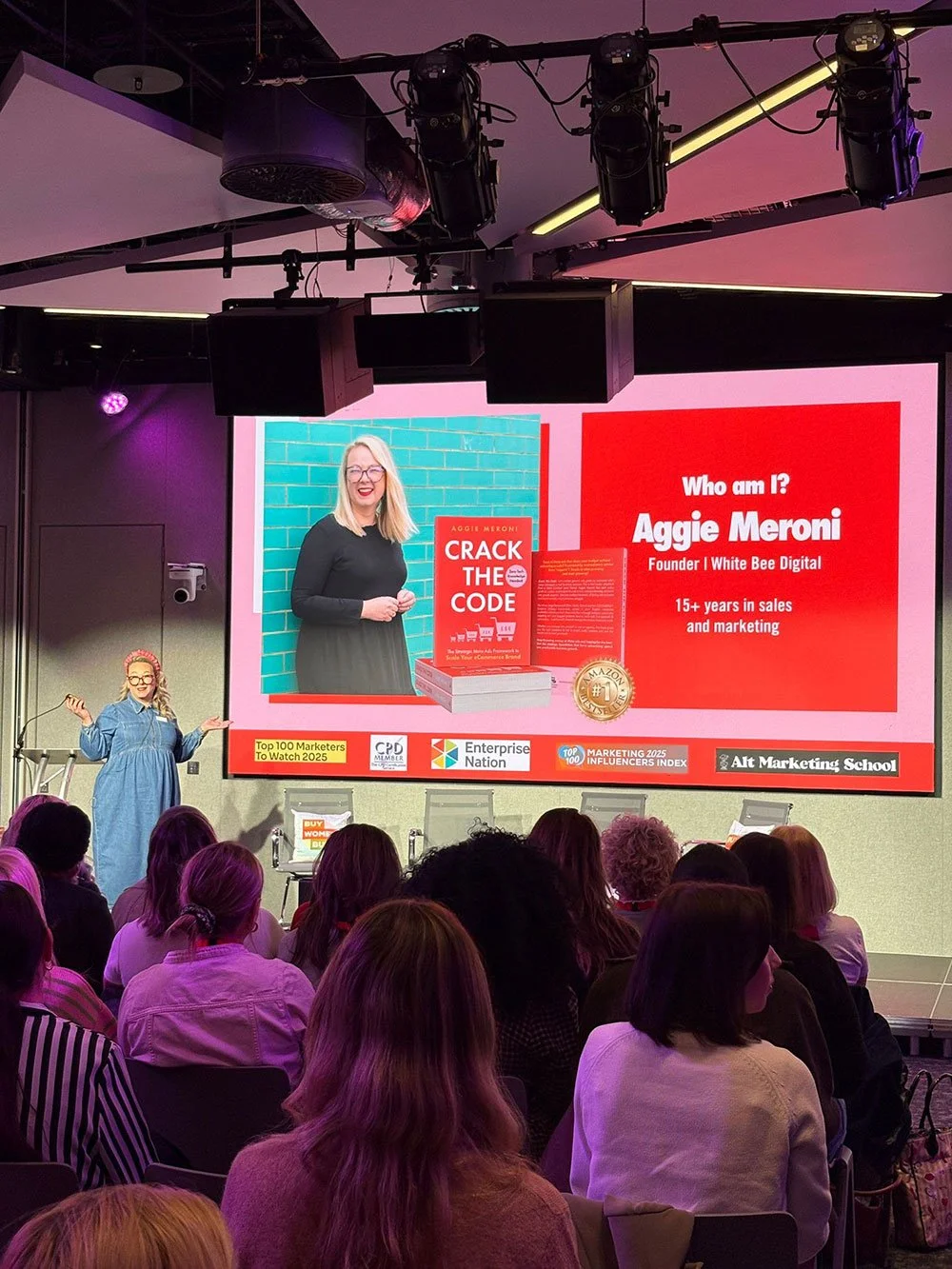
White Bee Digital is a London-based Meta Ads agency specialising in scaling ambitious eCommerce brands. The COLOURFUL™ Creative Strategy Framework is a trademarked proprietary process developed by Aggie Meroni, founder of White Bee Digital and author of Crack the Code.